
Why companies choose to outsource employees in 2025

In 2025, outsourcing remains a pivotal strategy for businesses aiming to enhance efficiency, access specialized talent, and achieve cost savings. While traditional motivations like cost reduction persist, companies are increasingly outsourcing to address evolving business needs and technological advancements.
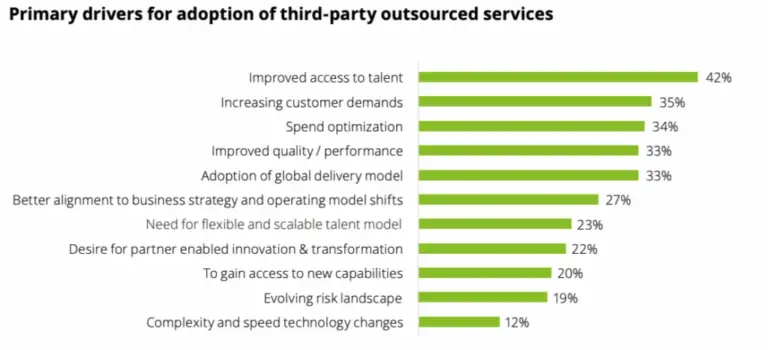
Source: Deloitte
According to a Deloitte survey more than 40% of companies cite improved access to talent as the main reason for outsourcing, highlighting a key trend: the strategic use of external suppliers to fill skills gaps. This indicates that businesses are increasingly turning to outsourcing not only to cut costs, but also to acquire specialized expertise and talent that they may be lacking internally, particularly in fast-moving areas such as IT.
Also, other key reasons driving companies to choose external sourcing in 2025 include increasing customer demands, spend optimization, improved quality and performance, as well as the adoption of global delivery models. This data reflects how outsourcing strategies are evolving to meet complex business requirements and ensure competitive advantage beyond simple cost reduction.
Considering the dynamic changes in the global market and the need for greater efficiency, the main reasons why companies choose to outsource employees in 2025 can be outlined as follows:
- Access to specialized skills and talent
A significant shift has occurred in outsourcing priorities in recent years that marks a turning point in the way companies approach external partnerships, moving from a purely financial perspective to a more strategic, capability-driven model.
The trend reflects an increasing need for high-level expertise in fast-evolving fields such as cybersecurity, data science, software engineering, and digital marketing — areas where internal resources may lack either the depth or the speed to keep up with market demands. By outsourcing these functions, organizations gain rapid access to global talent pools, advanced technical knowledge, and niche skill sets that are difficult and costly to build in-house.
- Cost efficiency and operational savings
Despite the growing emphasis on acquiring specialized talent, cost efficiency continues to be a core reason why companies choose to outsource in 2025. Reducing operational expenses remains a crucial objective for businesses striving to remain competitive in an increasingly globalized and fast-paced economy.
Outsourcing enables organizations to significantly cut costs associated with recruiting, onboarding, training, and retaining full-time, in-house employees. Beyond salaries, companies can also save on infrastructure, office space, equipment, and employee benefits, particularly when outsourcing roles to regions with lower labor costs.
- Integration of AI and Automation
The rise of artificial intelligence (AI) and automation is significantly transforming the landscape of outsourcing. In 2025, more companies are integrating intelligent technologies into their outsourcing strategies to streamline operations and boost overall productivity. Routine and repetitive tasks such as data entry, basic customer support, and certain IT functions are increasingly being handled by AI-powered tools and automated systems.
This shift not only reduces the need for manual intervention in standardized processes but also improves accuracy, speed, and scalability. As a result, human workers can be reallocated to more strategic, creative, and value-generating roles such as problem-solving, innovation, and client engagement, where human judgment and emotional intelligence are essential.
- Scalability and flexibility
Outsourcing provides businesses with a high degree of operational flexibility, enabling them to scale their workforce up or down in response to fluctuating market demands. This adaptability is especially valuable in today’s volatile and fast-changing business environment, where consumer behavior, technological trends, and economic conditions can shift rapidly.
Unlike traditional in-house hiring which often involves lengthy recruitment cycles, contractual obligations, and fixed overhead, outsourcing allows companies to adjust their resources quickly and efficiently. Whether it’s expanding a team to meet seasonal demand, entering a new market, or downsizing during economic downturns, outsourcing offers a responsive and low-risk solution.
- Compliance and data security
With the growing complexity of global regulations and the rising importance of data security, companies are placing greater emphasis on compliance and risk management when choosing outsourcing partners. In 2025, organizations are no longer focused solely on cost or efficiency, they also expect third-party providers to uphold rigorous security protocols and demonstrate full adherence to international legal and regulatory standards.
This shift is largely driven by the increasing volume of sensitive data being handled across borders, combined with stricter regulations such as GDPR and various national data protection laws. Any lapse in compliance can result in severe financial penalties, legal consequences, and reputational damage.
In 2025, outsourcing evolved far beyond its original role as a simple cost-cutting tactic. It has become a vital strategic tool that enables companies to access specialized skills, adopt emerging technologies, and respond with agility to shifting market dynamics. Businesses are increasingly using outsourcing not just to reduce overhead, but to unlock innovation, drive digital transformation, and strengthen their long-term resilience.
In an era defined by constant change, competitive pressure, and digital acceleration, outsourcing serves as a flexible and forward-looking solution. Companies that embrace it thoughtfully and strategically are better positioned to thrive in the evolving global business landscape.